INDIA
 USA
How Is AI Used in Hospitals? 10 Practical Uses, Benefits and Limits
AI in hospitals means computer programs that learn from data and help staff with tasks like reading scans, writing notes, booking appointments and checking bills. In India today, most hospital AI works as a helper. It prepares a draft or flags something, and a doctor or staff member checks it and decides.
You may have heard that AI will change healthcare. That is partly true, but the real picture is simple. Some uses are already common. Some are still being tested. Some need strong human checks. This guide explains 10 practical uses of AI in hospitals, what each one can and cannot do, and what Indian hospitals and clinics should keep in mind.
What Does “AI in Hospitals” Mean?
AI is a big word. In a hospital, it usually means one of these four things:
- Rule-based programs. They follow “if this, then that” steps, such as a warning when stock is low.
- Machine learning. It finds patterns in past data to make a guess, such as how many beds will be needed tomorrow.
- Computer vision. It looks at images, such as X-rays and scans.
- Language AI. It reads and writes text, such as a draft summary or a typed note.
Not every task needs the newest AI. A 2026 report on AI in Indian healthcare by Bain & Company and HealthQuad makes a useful point. Many hospital tasks are better served by simple rules, basic automation, machine learning or computer vision. The best hospitals match the tool to the job.
AI Uses in Hospitals at a Glance
| Use | What AI does | Who checks |
|---|---|---|
| 1. Reading scans | Marks areas that may need a closer look | Doctor or radiologist |
| 2. Writing notes | Turns a consultation into a draft note | Doctor |
| 3. Discharge summaries | Collects data from records into a draft | Doctor |
| 4. Reading handwriting | Turns paper prescriptions into digital text | Staff or doctor |
| 5. History summaries | Shortens long past records | Doctor |
| 6. Appointments and queues | Books slots and sends reminders | Front desk |
| 7. Billing and claims | Spots missing or wrong entries | Billing team |
| 8. Patient flow and beds | Guesses busy times and discharges | Admin team |
| 9. Early warnings | Flags patients who may get worse | Doctors and nurses |
| 10. Stock and supplies | Predicts demand and warns about expiry | Store and pharmacy staff |
10 Ways AI Is Used in Hospitals
1. Reading medical images
Computer vision can look at X-rays and scans and mark areas that may need a closer look. A good example for India is TB screening. The World Health Organization has recommended computer-aided detection (CAD) software for TB screening on chest X-rays since 2021, for people aged 15 and above. In June 2025, it approved six such products.
WHO also says that people who screen positive need a confirmatory test, and it does not yet recommend this software for children below 15. So the software helps to screen and sort. It does not give the final diagnosis.
2. Writing clinical notes
Some tools listen to a consultation, with the patient’s consent, and write a draft note. The doctor reads it, edits it and signs it. The Bain report names this “ambient scribing” among the uses with the clearest gains so far. One hospital group in the report said prescriptions are now drafted in under a minute, with about 90 per cent needing no edits. That is one hospital’s report, so your results may be different.
3. Making discharge summaries
At discharge, a doctor must gather notes, test results, treatments and medicines into one document. AI can collect these from the patient’s record and prepare a draft. This can save time. But the doctor must read every line, because a wrong medicine or dose in a summary can cause harm.
4. Reading handwriting and paper records
Many Indian clinics and hospitals still use paper. According to Bain, the use of electronic medical records (EMR) in Indian hospitals has risen from 18 per cent in 2018 to about 35 per cent. This is mostly in large city chains. Most small and mid-sized hospitals still write on paper.
AI with OCR (optical character recognition) can read handwritten prescriptions and printed or scanned papers and turn them into searchable digital text. Handwriting can be hard to read, even for AI. So staff should check important details, such as medicine names and doses.
5. Summarising patient history
Doctors have little time in a busy OPD. AI can read long past records and show a short summary: earlier illnesses, medicines, allergies and test trends. This saves reading time. But the doctor should still look at the original record when something is important.
6. Booking appointments and managing OPD queues
AI chat tools can book or change appointments, send reminders and answer simple questions. Bain lists appointment scheduling among the uses that are ready to scale today. But it also notes that symptom-checker and chatbot tools for first contact have shown limited extra value so far. So use AI for slots and reminders, not for medical advice. See how this works in our guide to OPD software for a clinic.
7. Billing, coding and insurance claims
AI can check a bill for missing or wrong entries. It can help match diagnoses to codes. It can also flag claim papers that look incomplete before they go to the insurer. Bain says claims and billing are ready to scale because the risk is low and the output is easy to check. One hospital group in the report said that automating claim queries cut discharge time by six to seven hours. Again, that is one hospital’s result. Read more in our guide to medical invoicing software.
8. Predicting patient flow, beds and discharges
Machine learning can study past data. It can guess the busy hours, the beds needed tomorrow and the patients who may be ready to go home. This helps managers plan staff and beds. Bain lists patient flow and discharge prediction among the uses with the biggest gains so far. It needs clean digital data to work well. Our guide to hospital administration software shows how this fits into daily management.
9. Early warnings for patients who may get worse
Machine learning can watch vitals and lab results. It can raise an alert when a patient may be getting worse, for example, with signs of sepsis. Bain cites an example where such a tool flagged sepsis cases about five hours earlier than older methods. Alerts like this always need a clinician’s judgement. Bain also notes that inpatient AI is slower to spread in India, because it needs good digital records and device connections.
10. Managing stock and supplies
AI can forecast demand from past use, warn about items close to expiry and help decide when to reorder. Bain says AI is strongest in areas like procurement and back-office work, because the data is more organised and the risk is lower. For the basics, see our guide to the hospital inventory management system.
What AI Does Well, and Where It Falls Short
AI usually does well at:
- Repeating tasks with clear steps, such as reminders and bill checks
- Drafting text that a person then reviews
- Sorting and ranking items, such as which scan to read first
- Finding patterns in large amounts of data
AI often struggles with:
- Rare or unusual cases it has not seen before
- Messy or incomplete data
- Indian languages and local ways of writing, where tools need local testing
- Judgement and responsibility, which stay with people
The Bain report also says that the main barriers are not the AI models themselves. They are data quality, fitting AI into daily work, doctors’ trust and change management. It adds that clear financial returns are still hard to show in the short term.
How AI Can Help a Hospital
- Less paperwork. Staff can spend less time typing and searching for files.
- Fewer typing mistakes. Checks can catch missing or mismatched entries.
- Faster access to information. Summaries put the key facts in front of the doctor.
- Earlier alerts. Some tools flag a problem sooner, so people can act.
- Better planning. Predictions help with beds, staff and stock.
These are possible benefits, not promises. Results depend on the tool, your data and how well your team uses it.
Risks and Limits to Keep in Mind
- Wrong or made-up output. Language AI can write text that sounds sure but is wrong. Always check it.
- Bias. A tool trained on data from other countries may work less well for Indian patients, languages and handwriting.
- Privacy. Patient data is sensitive. Know where it is stored and who can see it.
- Too much trust. Staff may stop checking if the tool is right most of the time.
- Unclear responsibility. Decide who signs off each AI output, and what happens if it is wrong.
Rules and Guidance on Hospital AI in India
This is general information, not legal advice. Rules are still developing, so check the latest position with your legal adviser.
- ICMR guidelines. In 2023, ICMR released Ethical Guidelines for Application of AI in Biomedical Research and Healthcare. They cover ideas such as patient autonomy, safety, trust, data privacy and accountability.
- SAHI. The Health Ministry launched the Strategy for AI in Healthcare for India (SAHI) in February 2026. It is a national guidance framework for the safe, ethical, evidence-based and inclusive use of AI in healthcare.
- Medical device software. According to Bain, the drug regulator CDSCO issued draft guidance on medical-device software in October 2025. It does not yet clearly cover AI that learns or acts on its own.
- Data protection. The Digital Personal Data Protection Act, 2023 sets rules for handling personal data.
- ABDM. The Ayushman Bharat Digital Mission supports sharing of health records with the patient’s consent. See how ABHA works at the front desk.
How a Hospital or Clinic Can Start With AI
- Pick one clear problem. For example, slow discharges, or too much paperwork.
- Start with low-risk, easy-to-check tasks. Reminders, billing checks and turning paper into digital records are good first steps.
- Check your data. If records are on paper, digitise them first. Our guide to hospital EMR systems can help.
- Keep a person in the loop. Decide who reviews each AI output before it is used.
- Run a small pilot. Try it for 30 to 90 days, with one clear measure, such as time taken per discharge summary.
- Train your staff and ask for feedback. People use tools they understand.
- Review every month. Keep what helps. Stop what does not.
Questions to Ask Before You Buy AI Hospital Software
- What exact task does the AI do?
- Who checks the output, and can we edit it?
- How was it tested for Indian patients, handwriting and languages?
- Where is patient data stored, and who can see it?
- Can we switch the AI off without losing our records?
- How does it connect with our existing records and billing?
- What happens when the AI is wrong?
- What is included in the price, and what costs extra?
- Can we see a demo with our own cases?
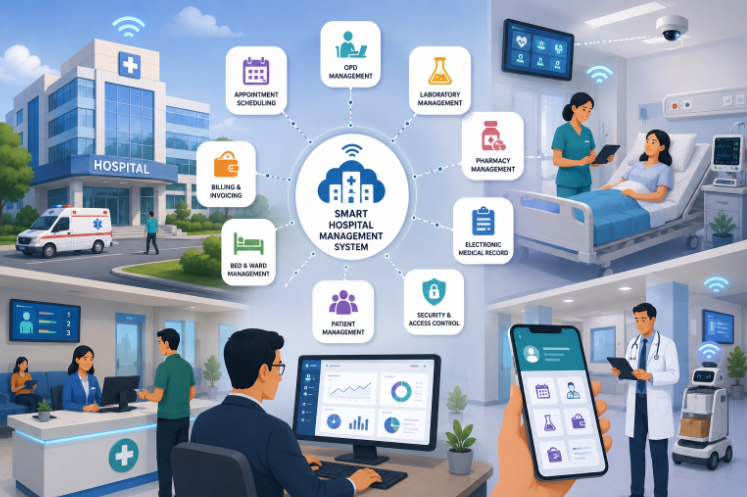
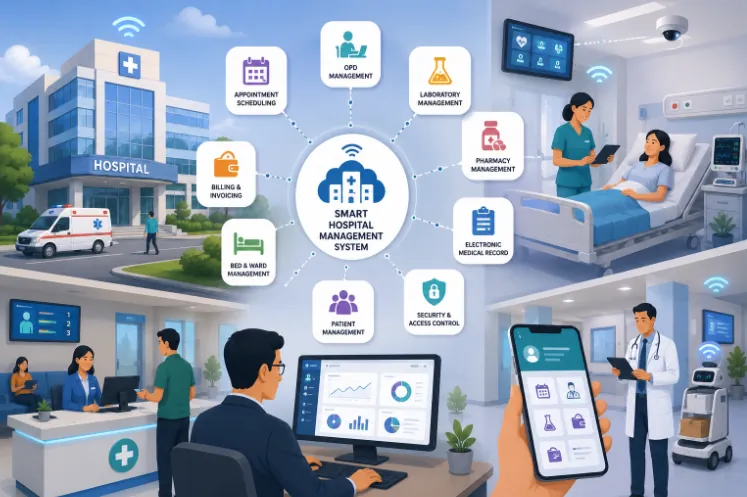
You can also read our guides to a smart hospital management system and the best hospital management software in India for more on choosing software.
Frequently Asked Questions
How is AI used in hospitals?
Hospitals use AI to read scans, draft clinical notes and discharge summaries, and read handwritten prescriptions. They also use it to summarise patient history, book appointments and check bills and claims. Other uses are predicting busy times and bed needs, warning about patients who may get worse, and planning stock. In most cases, a doctor or staff member checks the output.
Will AI replace doctors and nurses?
No. A 2026 Bain report says AI in Indian healthcare is still largely assistive. It helps draft and summarise, and it rarely works on its own. Doctors and nurses stay responsible for care decisions.
Is AI already used in Indian hospitals?
Yes, but unevenly. It is mostly used for documentation, scheduling, claims and some scan reading, and mainly in larger hospitals. Many small and mid-sized hospitals still keep records on paper, which makes AI harder to use.
Is AI safe to use in hospitals?
It can be, when it is tested, when staff check its output, and when patient data is protected. No AI tool is perfect, so important results should always be reviewed by a qualified person.
Can small hospitals and clinics use AI?
Yes. They can start with simple, low-risk tasks such as appointment reminders, billing checks and turning paper records into digital ones, and add more later.
What is the difference between AI and automation?
Automation follows fixed rules, for example, sending a reminder when stock is low. AI learns patterns from data or works with text and images. Many hospital tasks need only simple automation.
Does AI make medical decisions?
It can support decisions by flagging risks or preparing information, but doctors make the decisions. For higher-risk tasks, such as medicine orders or scan reports, a clinician should always sign off.
How much does AI hospital software cost in India?
Prices vary. The main factors are the number of users and beds, the AI features you choose, cloud or on-premise setup, data migration, training and support. Ask for a written quote that shows what is included and what costs extra.
Related reading: Smart Hospital Management System in India · Best Hospital Management Software in India · What Is a Hospital Information System (HIS)? · Hospital Administration Software in India · Medical Invoicing Software in India
Conclusion
So, how is AI used in hospitals? Mostly as a smart helper. It reads, drafts, sorts, predicts and reminds, and people check the result and make the decision. The safest way to start is small: pick one problem, choose a low-risk task, keep a person in charge and measure the result. Hospitals that do this are likely to learn faster and avoid costly mistakes.
Looking for AI-Ready Hospital Software in India? Consider iCAN Careflow
iCAN Careflow is a cloud-based hospital management system made for hospitals and clinics in India. Along with OPD, IPD, OT, ward, lab and billing modules, it offers ABHA integration and AI features. The AI features can:
- read handwritten prescriptions using OCR,
- pull patient details from printed and scanned papers,
- study patient history and give insights,
- draft patient summaries and discharge summaries for your doctors to review.
If you want AI that helps your staff without taking decisions away from them, iCAN Careflow is a good choice to shortlist. Ask for a demo and test it with your own cases before you decide.