INDIA
 USA

Smart Hospital Management System in India: Features, Benefits and How to Choose
A smart hospital management system in India is a connected software platform that links patient records, appointments, lab, pharmacy, billing, beds and staff, and adds automation, real-time data and AI so that information moves between departments without manual effort. It helps hospitals cut errors, save time and give patients faster, clearer care.
Healthcare in India is changing fast, and technology sits at the centre of that change. A smart hospital management system is no longer an idea only for large corporate chains. It has become a practical need for hospitals of every size that want to reduce mistakes, save time and improve patient outcomes. This guide explains what “smart” really means, which features matter, how the system fits Indian rules such as ABDM, and how to choose one.
What Is a Smart Hospital Management System?
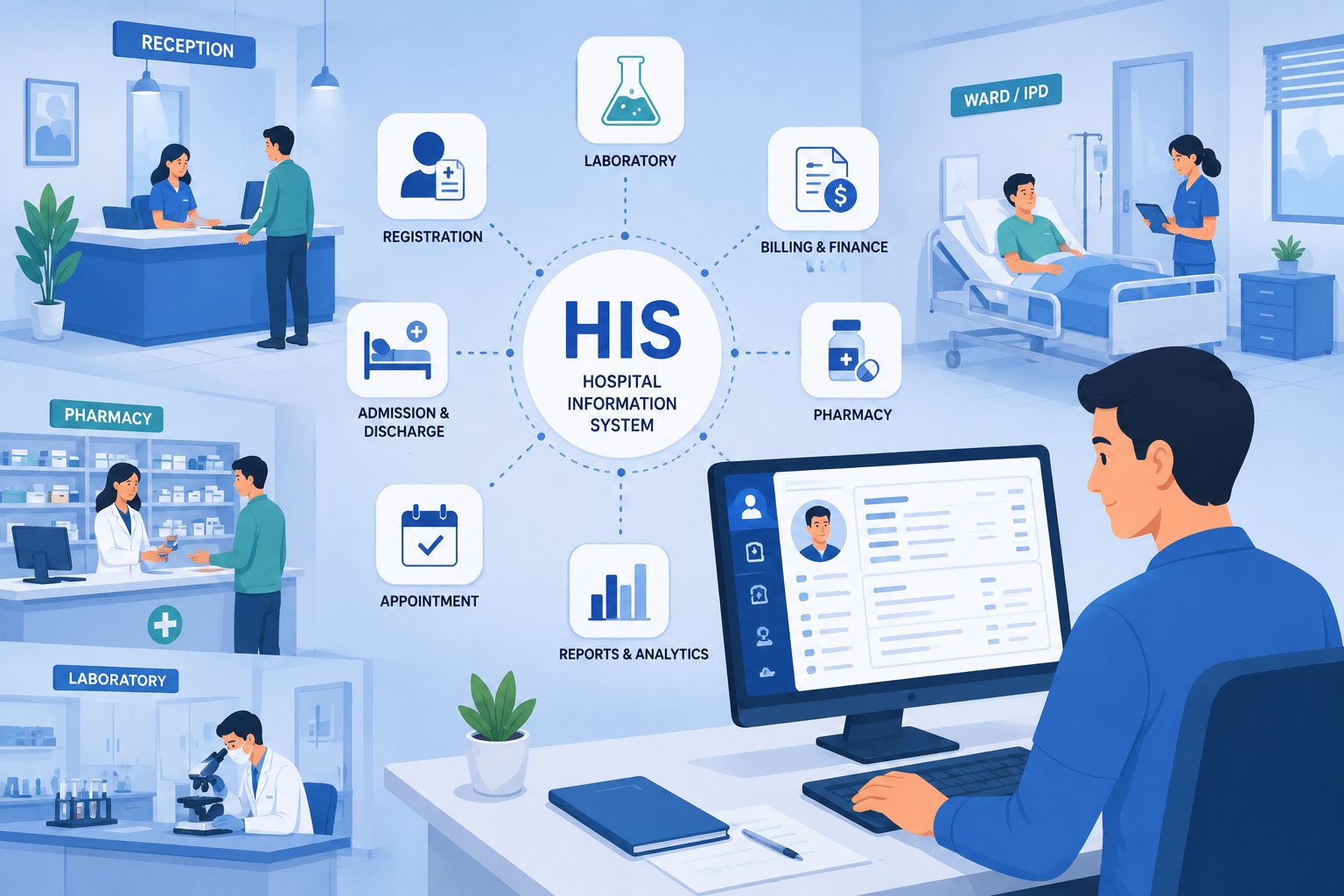
At its core, a smart hospital management system is a digital platform that connects every operational and clinical function of a hospital into one environment: patient records, staff scheduling, diagnostics, communication and resource tracking. In older, separate software, each department worked on its own. In a smart system, information moves instantly between teams.
This means a lab result created in one wing can update the doctor’s screen at once, a nurse can be alerted the moment a patient’s vitals cross a safe limit, and administrators can see bed occupancy without walking from floor to floor. It is not just software running in the background. It is an intelligent layer that supports decisions across the hospital.
The terms overlap. A smart system is a modern hospital management system (HMS) or hospital information system (HIS) that adds automation, live data and, in some cases, connected devices.
Traditional Hospitals vs Smart Hospitals: What Changes
The gap between conventional and connected hospitals is getting harder to ignore. These are the main differences.
| Area | Traditional hospital | Smart hospital |
|---|---|---|
| Data flow | Manual entry and paper trails | Data is shared automatically across departments |
| Response time | Updates can take hours | Alerts and updates arrive in seconds |
| Resource visibility | Beds, equipment and staff are estimated | Bed availability, equipment status and staff allocation are tracked live |
| Patient involvement | Patients depend on front-desk staff | Digital updates, reminders and access to their own records |
| Errors | Mismatches are often missed | Automated checks catch wrong doses, duplicate tests and missed follow-ups |
This shift is not about replacing human judgement. It is about giving doctors, nurses and administrators better information faster, so they can focus on care instead of paperwork.
Key Features of a Smart Hospital Management System in India
When you compare systems, look for these features.
- Connected modules. OPD, IPD, lab, pharmacy, billing and ward and bed management share one patient record.
- Real-time dashboards. Live numbers on patients, beds, revenue and waiting times.
- AI and automation. Reminders, billing calculations, stock alerts and AI-assisted records that cut manual typing.
- Device integration. Links to monitors, smart beds and storage sensors where they are used.
- Patient convenience. Online booking, SMS or app reminders, digital prescriptions and easy access to reports.
- ABDM and ABHA support. ABHA creation and consent-based record sharing.
- Analytics and reports. Trends that help you plan staff, stock and capacity.
- Security. Role-based access, activity logs and backups. See how to judge data security.
The Role of IoT in Smart Hospitals
Internet of Things (IoT) devices are quietly becoming one of the biggest contributors to smarter healthcare. Connected monitors, smart beds, wearable trackers and even temperature-controlled medicine storage can send live data straight into the hospital’s central system.
For example, a patient’s heart rate or oxygen level can be tracked continuously and flagged automatically if something looks wrong, instead of waiting for the next scheduled check. IoT-based equipment tracking also tells staff exactly where a ventilator, wheelchair or infusion pump is at any moment, which saves a lot of time in larger hospitals.
AI and Automation in Everyday Hospital Work
Artificial intelligence is playing a growing role in how hospitals run day to day. It can flag unusual scan results, help plan staff shifts based on patient load, and prepare records and summaries so that clinicians type less.
Automation, which works closely with AI, runs routine tasks such as appointment reminders, billing calculations and inventory reordering in the background without constant human effort. This is where a well-built hospital management software becomes valuable. It is the base that ties AI tools, automation rules and daily operations into one working system, instead of leaving each function to run on its own. Our guide to hospital administration software shows how this works for administrators.
Real-Time Data and Predictive Analytics
One of the most powerful advantages of a connected system is real-time data. Instead of waiting for end-of-day reports, administrators and doctors can see what is happening as it happens: current bed occupancy, ongoing procedures, pending lab results or staff availability.
Predictive analytics goes one step further. By studying past patient data and current trends, hospitals can expect patient surges in certain seasons, spot patients at higher risk of coming back, and plan staff and stock in advance. This turns hospital management from reactive to proactive, which saves time and cost and improves patient safety. A 2024 review of smart hospital technologies in India looked at this kind of impact on patient-centred care, errors and efficiency.
Interoperability: Connecting Every Department
A smart hospital is only as good as its ability to connect departments smoothly. Interoperability means OPD scheduling, IPD bed management, billing and inventory do not work as separate islands. They exchange data automatically, so information entered once does not need to be typed again.
For instance, when a patient moves from OPD to IPD, the history, prescriptions and billing details should carry over without manual copying. In the same way, when inventory and billing stay in sync, the medicines used during a stay show correctly in the final bill, without back-and-forth between departments. Our guide on hospital inventory management shows how stock and billing connect.
Better Patient Experience Through Technology
Patients now expect the same convenience from hospitals that they get from other digital services. Online appointment booking, SMS or app reminders, digital prescriptions and easy access to reports all make the visit smoother.
Smart systems also cut waiting time. Live queue updates, faster lab results through connected systems and quicker billing mean patients spend less time waiting and more time being cared for. For the hospital, this means better patient satisfaction and a stronger name in a competitive market.
Smart Hospitals in India: Rules and Standards to Know
This is general information, not legal advice. Check the current rules for your state.
- ABDM and ABHA. The Ayushman Bharat Digital Mission lets patients create an ABHA health ID and share records with consent. A smart system should support this.
- NHCX. The National Health Claims Exchange lets hospitals and insurers exchange claims in one digital format. According to a Ministry of Health release, as on 21 July 2024 about 34 insurers and TPAs were live and around 300 hospitals were getting ready.
- NABH accreditation. NABH expects documented processes and consistent records, which connected software makes easier to keep.
- Data protection. The Digital Personal Data Protection Act, 2023 sets rules for handling personal data.
Challenges for Indian Hospitals, and How to Handle Them
Smart systems bring real benefits, but adoption is not always easy. Industry reports often point to infrastructure cost as the main barrier. These are the common hurdles.
- Cost. Start with core modules and add devices later. Cloud software lowers the upfront spend.
- Internet reliability. Ask how the system behaves if the connection drops, and plan a backup connection.
- Staff comfort. Choose simple screens, and budget time for training.
- Old data. Ask how existing patient and billing records will be moved without loss.
- Data safety. Look for access control, activity logs and backups from day one.
Cloud or On-Premise?
A cloud system runs on the vendor’s secure servers. It costs less to start, updates itself and lets you view reports from anywhere. An on-premise system runs on your own servers, which gives direct control but needs space, backups and IT staff. We compare both in our HIS guide.
What Affects the Cost?
- The number of beds, users and branches
- The modules you choose
- Cloud or on-premise setup
- Device and machine integration
- Data migration and staff training
- Support hours and updates
Ask for a written quote that shows what is included and what costs extra.
How to Choose a Smart Hospital Management System in India
- List your problems first. Decide which departments must go live first.
- Ask for a live demo. Use your own cases, such as an OPD visit, an admission and a discharge bill.
- Check how connected it really is. Does data move between OPD, IPD, lab, pharmacy and billing without re-typing?
- Test the automation. Ask what runs by itself, such as reminders, alerts and billing checks.
- Ask about ABDM and claims. Check what is working today, including ABHA and NHCX readiness.
- Review security. Look for role-based access, activity logs, encryption and backups.
- Plan the move. Ask how old records will be shifted and what training is included.
- Speak to a similar hospital. A customer of your size can tell you what daily use is like.
Start small. Go live with the busiest departments first, then add the rest and any connected devices once your team is comfortable.
The Future of Smart Hospitals in India
India’s healthcare sector is moving steadily towards digital adoption, driven by government efforts on digital health records and by growing patient expectations for faster, clearer care. Hospitals in tier 2 and tier 3 cities, which were slower to adopt technology, are now investing in smart systems to compete with larger city hospitals.
As connectivity improves and cloud infrastructure becomes more affordable, future systems are likely to include deeper AI-based support, wider use of wearable monitoring, and tighter links between hospitals, diagnostic labs and pharmacies. Hospitals that adopt these systems early will be better placed to handle growing patient numbers without compromising care quality.
Frequently Asked Questions
What is a smart hospital management system?
It is a digital platform that connects a hospital’s clinical and administrative work, such as patient records, appointments, lab, pharmacy, billing and beds, and adds automation, real-time data and, where needed, connected devices so that information moves between teams on its own.
What is the main benefit of a smart hospital management system?
The biggest benefit is connected, real-time visibility across departments. Doctors, nurses and administrators all work with the same updated information instead of relying on delayed reports or manual coordination.
How is a smart hospital different from a regular digital hospital system?
A regular digital system may only digitise records. A smart hospital management system goes further by connecting devices, automating routine tasks and using data actively for alerts and predictions, not just storage.
Is IoT necessary for a hospital to be considered “smart”?
Not strictly, but it adds a lot. Common IoT uses are continuous patient vital monitoring, real-time equipment tracking and smart medicine storage with temperature alerts.
Are smart hospital systems suitable for small and mid-sized hospitals in India?
Yes. Many platforms are built to scale, so smaller hospitals can start with core features such as connected OPD and IPD workflows and automated billing, and add more as their needs grow, without changing their whole infrastructure.
Does a smart hospital management system support ABDM and ABHA?
Good ones do. Ask the vendor which ABDM steps are live, such as ABHA creation and consent-based sharing of records, and ask to see them working. Check the latest rules for your state before you decide.
How much does a smart hospital management system cost in India?
Prices vary widely. The main factors are the number of beds and users, the modules you choose, cloud or on-premise setup, any device integration, data migration, training and support. Ask for a written quote that shows what is included and what costs extra.
Is patient data safe in a smart hospital system?
It can be, if the vendor uses role-based access, encryption, activity logs and regular backups, and follows the Digital Personal Data Protection Act, 2023. Ask for these details in writing.
Related reading: What Is a Hospital Information System (HIS)? · Hospital Administration Software in India · Best Hospital Management Software in India · Hospital EMR Systems
Conclusion
The move to a smart hospital management system is not just a technology upgrade. It is a change in how hospitals think about patient care, efficiency and growth. With IoT, AI, automation and real-time data working together, hospitals across India are better able to meet rising patient expectations while reducing the load on their staff. The hospitals that invest in connected systems today will set the standard for advanced healthcare tomorrow.
Ready to Bring Your Hospital Into the Smart Healthcare Era?
iCAN Careflow helps hospitals across India move from manual processes to a connected hospital management system, from OPD and IPD to lab, billing and ABHA integration. See how it can work for your hospital.