INDIA
 USA
Medical Invoicing Software in India: Features, Benefits and How to Choose
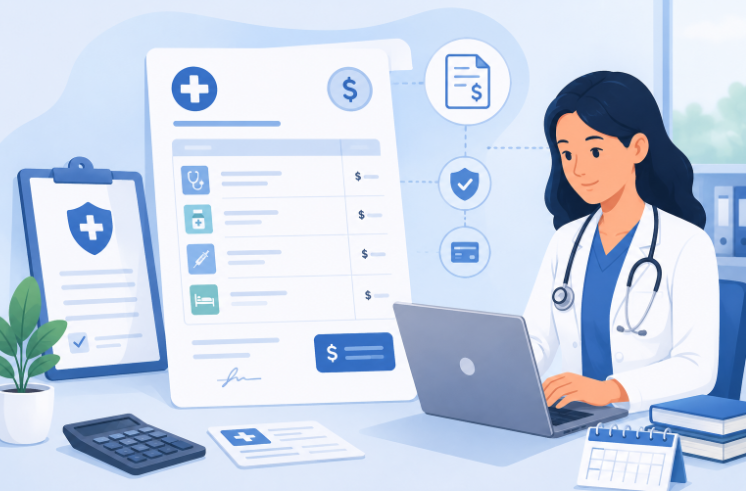
Medical invoicing software is a digital system that creates itemised bills for consultations, tests, medicines, procedures and hospital stays, records every payment, and keeps all billing data in one place. In India, good software also handles GST, TPA and insurance claims, and government schemes such as PM-JAY, so the bill is right the first time.
Ask any hospital accountant what keeps them awake at night, and billing mistakes will come up quickly. A missed charge, a duplicate entry, a discharge held up because the bill is not ready: these small slips add up fast. That is the gap medical invoicing software is meant to close. This guide explains how medical invoicing software works in India, which features matter, what the data says about billing accuracy, and how to choose the right one.
What Is Medical Invoicing Software?
A medical invoice is the itemised bill a patient, or their insurer, receives for the care they got: consultation fees, tests, medicines, room charges, procedures and so on. It sounds simple. But a single hospital stay can collect charges from four or five departments, each billed in its own way, and all of them must land on one final, correct document.
That is the real job of medical invoicing. It is not one bill. It is dozens of small charges that must be pulled together without anything getting lost or counted twice.
Clinics, nursing homes, hospitals, diagnostic centres, labs and pharmacies all use this kind of software. A small clinic may need quick invoices and payment tracking. A hospital needs much more: bed charges, advances, package rates, insurance and discharge billing.
Medical Invoicing vs Medical Billing vs Hospital Billing
People use these terms loosely. Medical invoicing is making an accurate, itemised bill. Hospital billing is wider: it runs from registration charges to final settlement and collection. In some countries, “medical billing” mostly means coding and claims to insurers.
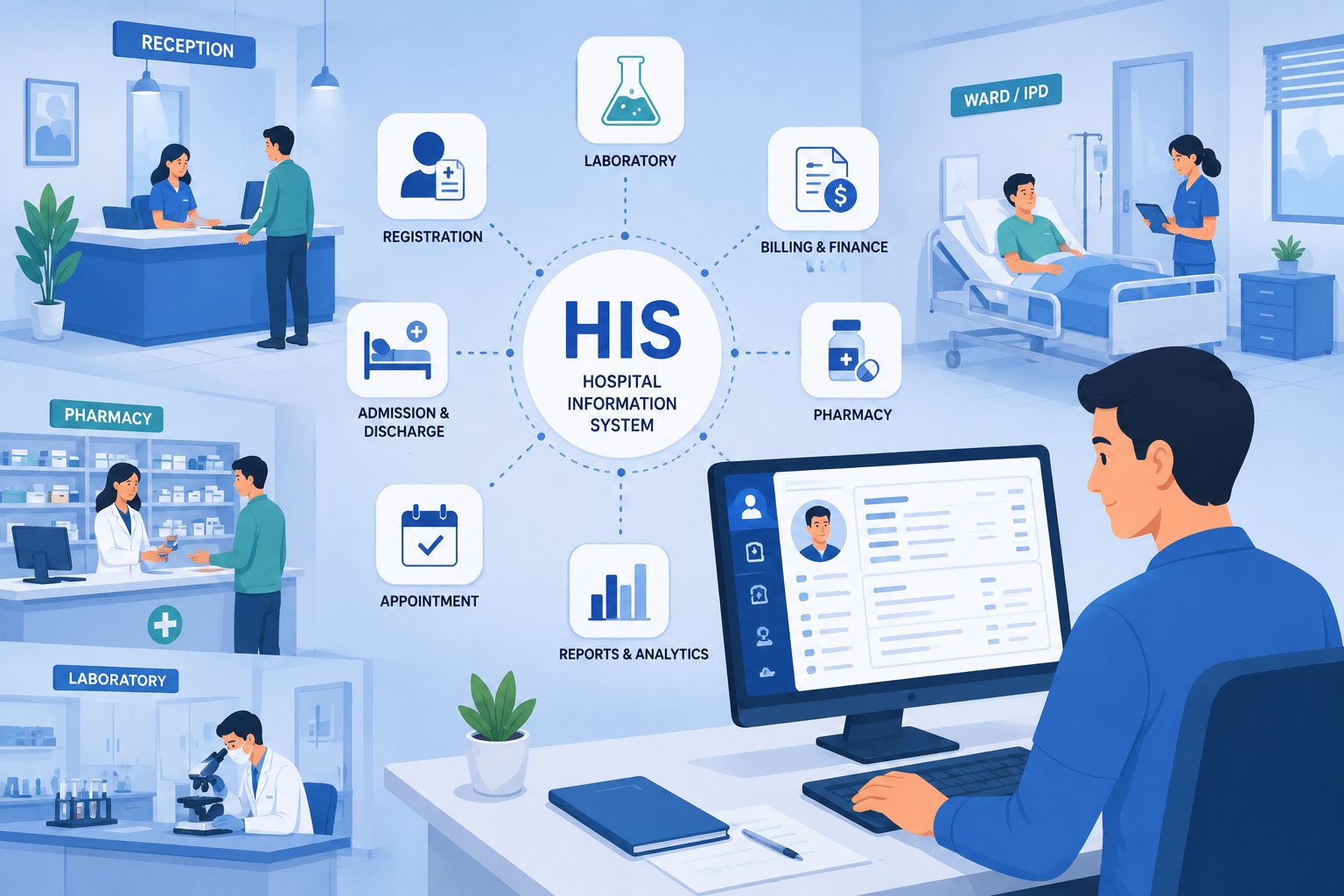
In India, most buyers use all three names for the same thing: software that gets the bill right and gets the money collected. When you compare products, ignore the name and check what each one actually does.
Why Manual Billing Stops Working as Patient Numbers Grow
With a handful of patients a day, manual billing is manageable. Someone writes it down, someone else double-checks it, and mistakes get caught in time. That falls apart once a hospital handles a few hundred patients across many departments. There is no time for manual cross-checking, and a slip that was once rare now happens many times a week.
This is usually when hospitals realise billing is not only an accounts problem. It decides how long patients wait, how fast insurance claims are settled, and how well the hospital understands its own revenue.
How Medical Invoicing Software Works
- Registration. Patient details are saved once, along with insurance or ABHA details where available.
- Charges are added as they happen. Consultation, tests, medicines, procedures and room rent are posted during care, not rebuilt at the end.
- Rates and tax are applied. Price lists, packages, discounts and GST rules work automatically.
- The bill is generated. An itemised bill is ready in seconds, with approval steps for discounts.
- Payment is recorded. Cash, card, UPI, advances and part-payments are tracked, and receipts are issued.
- The insurance claim is prepared. For cashless and TPA cases, documents are drawn from the same record.
- Reports update. Daily collection, pending dues and department-wise revenue are ready without manual totals.
Billing Looks Different Depending on Where Care Happens
One thing that trips up many billing systems is treating every visit the same way. In reality, billing needs change with the setting.
OPD billing
Outpatient billing is quick: a consultation fee, maybe a test or two, paid and closed in the same visit. The challenge is speed. If OPD billing is slow, the whole front desk gets backed up.
IPD billing
Inpatient billing is a different matter. Charges build up over days: room rent, doctor visits, nursing, medicines and procedures. The final bill comes together only at discharge. If something is not tracked along the way, it is either missed or causes a scramble just when the family wants to leave.
Pharmacy billing
Medicines given to inpatients must tie back to the main hospital bill, while walk-in pharmacy sales are billed separately and at once. Keeping both flows clear, without losing track of either, is harder than it sounds. Our guide to hospital inventory management shows how stock and billing connect.
Diagnostics billing
Lab tests and scans are often ordered by a doctor but paid for separately, sometimes before results are ready. Diagnostics billing must link back to the patient’s file so charges are not left orphaned from the rest of the bill.
Key Features to Look For
| Feature | Why it matters |
|---|---|
| Itemised OPD and IPD billing | Charges from every department come into one bill, with no re-typing |
| Package and tariff management | Fixed surgery packages, and different rates for cash, insurance and scheme patients |
| GST and tax settings | Tax can be set for each item or service |
| Advances, deposits and refunds | Advances are adjusted correctly at discharge, and refunds are tracked |
| Many payment modes | Cash, card, UPI and net banking, with POS machine support |
| Insurance, TPA and scheme billing | Claim documents, pre-authorisation tracking and PM-JAY packages |
| Discount approval and audit trail | You can see who changed which charge, and when |
| Dues and ageing reports | Pending amounts are visible by 30, 60 and 90 days |
| Access control and backups | Only the right staff see the right data, and nothing is lost |
Insurance, TPA Claims and Government Schemes in India
A large share of hospital revenue in India runs through insurance or TPA (Third Party Administrator) claims, and this is where billing gets complicated. Claims need supporting documents and, in many cases, pre-authorisation. They must also match exactly what the insurer’s policy covers. Any mismatch and the claim bounces back, delaying payment for weeks.
If you treat patients under PM-JAY, your bills must follow scheme packages and claim steps. The National Health Authority publishes the current rules.
There is also a newer development: the National Health Claims Exchange (NHCX), built under the Ayushman Bharat Digital Mission. It lets hospitals and insurers exchange claims in one standard digital format. According to a Ministry of Health release, as on 21 July 2024 about 34 insurers and TPAs were live on NHCX and around 300 hospitals were getting ready to send claims. Ask every vendor whether the software is ready for it, and how it works with ABHA integration.
GST and Tax Rules: Do Not Leave Them to Memory
GST treats healthcare differently. Many clinical services are exempt, while some items, such as medicines or consumables sold, can be taxable. Getting this wrong is not just a billing mistake. It is a compliance problem.
Rules change, so confirm the current position with your chartered accountant and check the official GST portal. Your software should let you set the tax treatment for each item, so the right rate is applied automatically, instead of depending on whoever is at the counter that day.
What the Numbers Say About Billing Accuracy in India
No honest vendor can promise one “success rate” for every hospital, because results depend on how well the software is set up and used. But public data and published case studies show why accurate billing matters, and what digital billing has achieved.
- 82.46% of claims paid. In 2023-24, insurers received about 3.26 crore health insurance claims, including those pending from the year before, and paid about 2.69 crore of them. Source: IRDAI data given in Parliament.
- About ₹26,000 crore disallowed or repudiated. Claims worth ₹15,100 crore were disallowed under policy terms and ₹10,937 crore were repudiated in the same year. Not every rejection is a billing error, but clean and complete bills remove the avoidable ones. Source: Lok Sabha reply.
- 885 to 1,262 in every 10,000. Insurers repudiated between 885 (private general insurers) and 1,262 (public sector insurers) of every 10,000 claims received. Same source.
- 332 minutes against a 180-minute benchmark. One audit at an Indian hospital found self-paying patients waited 332 minutes on average at discharge, against the NABH benchmark of 180 minutes, with billing and insurance steps among the causes. It shows that software alone is not enough; setup and training matter. Source: published audit.
- About 15% less revenue leakage and a 60% faster discharge cycle. A large private hospital in India reported these results after charges were captured in real time at the point of care. This is a vendor-published case study, so treat it as an example, not a promise.
So when you talk to a vendor, ask for numbers from hospitals like yours: time to create a bill, billing error rate before and after, claim rejection rate, and days taken to collect dues.
Benefits of Medical Invoicing Software
Tracking Payments, Refunds and Reports
Creating the invoice is only half the job. Someone must also track whether it has been paid. Without a proper system, these things tend to slip:
- Part-payments that are never followed up
- Refunds owed after a cancelled procedure or an overcharge
- Dues that quietly age past 30, 60 or 90 days
- Advances taken at admission that are not adjusted correctly at discharge
None of these looks serious alone. Across hundreds of patients a month, though, the unpaid or unreconciled amount can become a big loss, and nobody notices until the books are finally reconciled.
A billing report should answer clear questions. Which department earns the most? How much is outstanding, and how old is it? Are refunds being processed on time? Good reports also help during audits, because you can show a clean trail instead of digging through files.
Common Billing Errors That Quietly Cost Hospitals Money
- Charges entered by hand that do not match the service given
- Duplicate billing when a patient moves between departments
- Wrong GST on bills that mix different kinds of services
- Bills made before all charges, such as late lab results, have come in
Each looks small. Over a year, they can cost a mid-sized hospital a lot, either in lost revenue or in staff time spent fixing disputes.
Cloud or On-Premise, and Is the Data Safe?
Cloud software runs on the vendor’s secure servers. It costs less to start, updates itself and lets you check reports from anywhere. On-premise software runs on your own servers, which gives you direct control but also needs space, backups and IT staff. We compare both in our HIS guide.
Billing data is personal data, so look for role-based access, activity logs, encryption and regular backups. The Digital Personal Data Protection Act, 2023 sets the rules for handling it. Our page on data security explains what to check.
What Affects the Cost?
- The number of users, beds and branches
- The modules you choose, such as OPD, IPD, pharmacy and lab billing
- Cloud or on-premise setup
- Data migration and staff training
- Links to payment machines, lab machines or insurance systems
- Support hours and updates
Ask for a written quote that shows what is included and what costs extra.
How to Choose the Right Medical Invoicing Software
- Write down your needs. Do you need only OPD billing, or IPD, pharmacy, lab and insurance too?
- Test your own bills. Ask for a demo using a real OPD visit, an IPD stay and a cashless case.
- Check GST handling. Can tax be set for each item or service?
- Check insurance depth. Ask about TPA documents, pre-authorisation, PM-JAY packages and NHCX.
- Look at dues and refunds. Can you see pending amounts without spreadsheets?
- Review security. Ask about access control, activity logs and backups.
- Ask for real numbers. Request results from hospitals of your size, and speak to one of them.
- Plan the move. Ask how old billing records will be shifted and what training is included.
Three mistakes to avoid: choosing on price alone, switching every department on the same day, and skipping staff training. Start with OPD, then add IPD and insurance once the team is comfortable. If you also want a wider system, see our guide to hospital administration software.
Frequently Asked Questions
What is medical invoicing software?
It is software that creates itemised bills for consultations, tests, medicines, procedures and hospital stays, applies the right rates and tax, records payments and keeps all billing data in one place. In India it also helps with TPA, insurance and government scheme billing.
Is medical invoicing software the same as medical billing software?
In India, most people use the two names for the same kind of software. Strictly speaking, invoicing is making the bill, while billing also covers collection and claims. Always check what the product actually does, not what it is called.
Can small clinics use medical invoicing software?
Yes. A small clinic can start with simple invoices, payment tracking and daily collection reports. As patient numbers, departments or insurance cases grow, it can move to a fuller system.
Does medical invoicing software handle GST?
Good software lets you set the tax treatment for each item or service, so the correct GST is applied automatically on mixed bills. Rules change from time to time, so confirm the current position with your chartered accountant.
Can it handle TPA, cashless and PM-JAY claims?
Many systems support claim documents, pre-authorisation tracking and scheme packages, but the depth varies. Ask for a demo of your own cashless case, and ask about NHCX readiness.
How much does medical invoicing software cost in India?
Prices range from low-cost billing apps for clinics to full hospital systems. The main factors are the number of users and beds, the modules you need, cloud or on-premise setup, data migration, training and support. Ask for a written quote that shows what is included.
Is patient billing data safe in cloud software?
It can be, if the vendor uses role-based access, encryption, activity logs and regular backups, and follows the Digital Personal Data Protection Act, 2023. Ask for these details in writing before you decide.
Related reading: Hospital Administration Software in India · What Is a Hospital Information System (HIS)? · Best Hospital Management Software in India · OPD Management Software in India · Hospital EMR Systems
Conclusion
Billing rarely gets attention until something goes wrong: a delayed discharge, a rejected claim, a refund nobody followed up. Good medical invoicing software in India is not about chasing a technology trend. It is about making sure the money side of patient care runs as smoothly as the clinical side. Get that right, and much of the daily friction around billing stops being a problem.
Simplify Your Hospital Billing with iCAN Careflow
iCAN Careflow brings OPD and IPD billing, lab, ward and OT charges, POS payments and ABHA integration into one system, so every charge lands on one accurate bill. See how it works for your hospital and your daily billing counter.