INDIA
 USA
Long OPD Lines? How a Hospital Queue Management System Works in India
A hospital queue management system is software that gives every patient a token number, shows on a screen who will be called next, and tracks the line at each counter and doctor’s room. It makes the wait clear and fair, so people stop crowding the desk to ask, “How much more time will it take?”
Anyone who has taken a parent to a busy hospital knows the picture. One line for the OPD slip, another to meet the doctor, a third for tests or medicines. Half the day goes in waiting. This guide explains how a queue management system works, which features matter, and how to choose one for an Indian hospital or clinic.
What Is a Hospital Queue Management System?
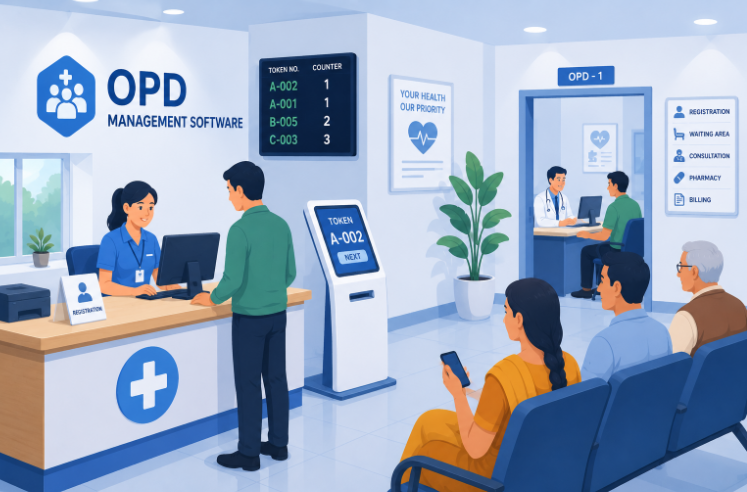
Think of the token system at a bank or a railway counter, but built for patients. When a patient registers, the system issues a token. It may be a printed slip, an SMS or a number on the mobile. A screen in the waiting hall shows which numbers are being served, and staff see the same line on their computer.
You may also hear it called an OPD token system, an e-token system, a patient queue system or patient flow management software. The names differ, but the idea is the same: every patient knows the turn, and the hospital can see where the crowd is building up.
A hospital is not a bank, though. One visit has many stops: registration, doctor, lab, scan, pharmacy and billing. Some patients need priority. And one doctor may take 3 minutes with one patient and 20 with the next. A good system is built for this.
Why OPD Lines Get So Long in India
- Everyone comes together. The morning rush is real.
- One counter does many jobs. Registration, payment and enquiries often share the same line.
- No clear information. Patients do not know how many people are ahead of them, so they keep asking the staff.
- Walk-ins and appointments are mixed. Without a system, it becomes hard to decide who goes next.
- Doctor time varies. Some cases are quick, and some take long.
- Many stops after the doctor. Lab, scan, pharmacy and billing each have their own line.
What Indian studies found
Waiting time differs from hospital to hospital. These studies give an idea:
- At a tertiary medical college hospital in Kolkata, the average wait from registration to the doctor’s room was about 99 minutes, while the average consultation lasted about 6.5 minutes. See the study abstract.
- At a tertiary hospital in Faridabad, the average wait was about 38 minutes at registration, 41 minutes for the doctor, 50 minutes for sample collection and 61 minutes for drug dispensing. Read it in the Indian Journal of Public Health.
- At a teaching hospital in Jharkhand, about 26 per cent of 400 patients waited more than 60 minutes at registration, and about 30 per cent waited more than 60 minutes before seeing the doctor. See the Cureus study.
- A busy tertiary hospital in Tamil Nadu recorded an average total wait of about 32 minutes in a time-motion study. So it is not the same everywhere.
One more point from the Kolkata authors: crowding also comes from patients with minor illnesses and unnecessary referrals going to big hospitals. A queue system cannot add doctors or fix this. What it can do is make the waiting visible and the order fair.
How It Works, Step by Step
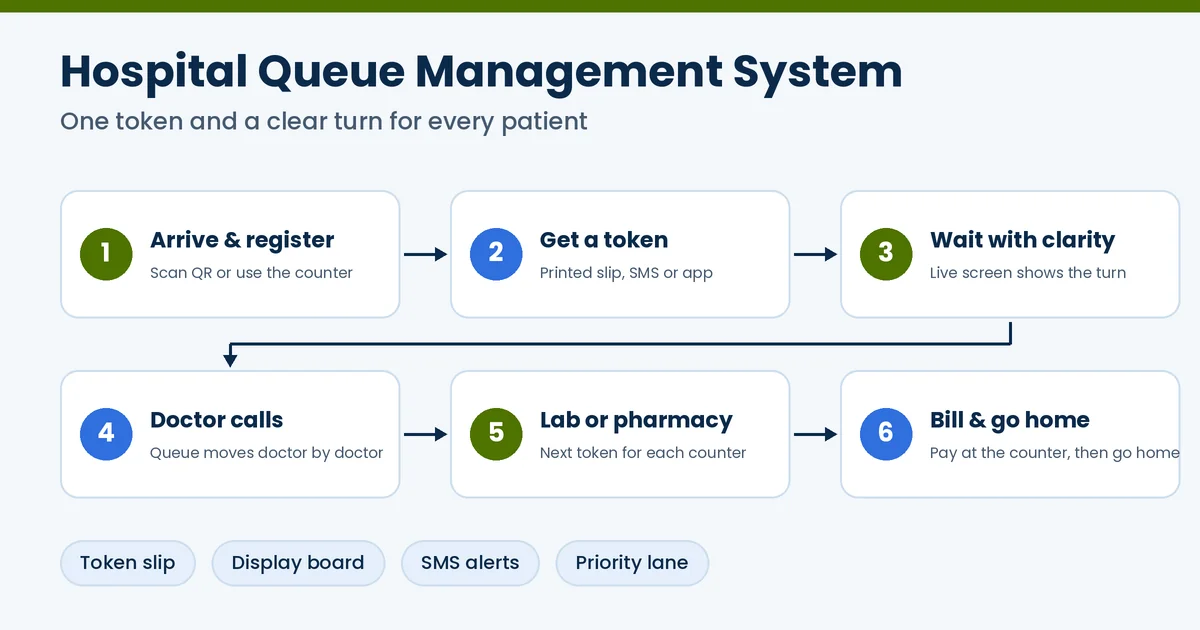
- Arrive and register. The patient registers at the counter, or scans the hospital’s QR code to share their ABHA profile.
- Get a token. A token number is issued for the doctor or service, as a printed slip, SMS or app message.
- Wait with clarity. A display board in the waiting hall shows the current number for each room. Some systems also give a voice call-out.
- Doctor calls the next patient. The queue moves as each consultation ends.
- Lab, scan or pharmacy. The patient gets a new token for the next counter, so they do not stand in line again from the start.
- Bill and go home. The patient pays at the billing counter and leaves.
- Reports for the hospital. The system records waiting times and busy hours, so managers can plan staff.
The ABDM Scan and Share service helps with step 1. According to a Ministry of Health release from June 2024, it had generated 3 crore OPD tokens in over 5,435 health facilities. Read about the Ayushman Bharat Digital Mission and see how ABHA works at the front desk.
Types of Queue Systems
| Type | How it works | Good for |
|---|---|---|
| Manual tokens | Paper slips and a hand-written board | Very small clinics |
| Basic token display | Token printer and a screen at the counter | Single-department waiting areas |
| SMS or app queue | Patient gets the turn status on the phone | Patients who want to wait outside or at home |
| Queue inside hospital software | Tokens linked with registration, doctors, lab and billing | Hospitals that want one system for the full visit |
Key Features to Look For
| Feature | Why it matters |
|---|---|
| Token for each doctor and service | Separate lines for each doctor, lab and counter |
| Display board and voice call-out | Patients and attendants know the turn without asking |
| Priority lane rules | Handles senior citizens, emergencies and special cases as per your policy |
| SMS or WhatsApp alerts | Patients can step out and come back when the turn is near |
| Local language support | Screens and messages that patients can read easily |
| Link with registration and billing | No need to type the same details again |
| ABHA Scan and Share support | Faster registration at the counter |
| Waiting-time reports | Shows busy hours and slow points |
Priority Patients and Fairness
In India, emergencies, senior citizens, pregnant women and patients with disabilities usually get priority. The software does not decide who deserves it. Your hospital does. Write down your rules in plain words, and set them in the system, so staff do not have to argue at the counter.
Who Can Gain From It
- Patients and attendants. They know their turn and can sit or step out.
- Front-desk staff. They get fewer “when is my turn?” questions.
- Doctors. They see who is waiting, with less crowding at the door.
- Owners and managers. They get data on busy hours and slow counters.
These are possible gains, not promises. Results depend on your hospital, your staff and how well the system is used.
Small Clinic or Big Hospital?
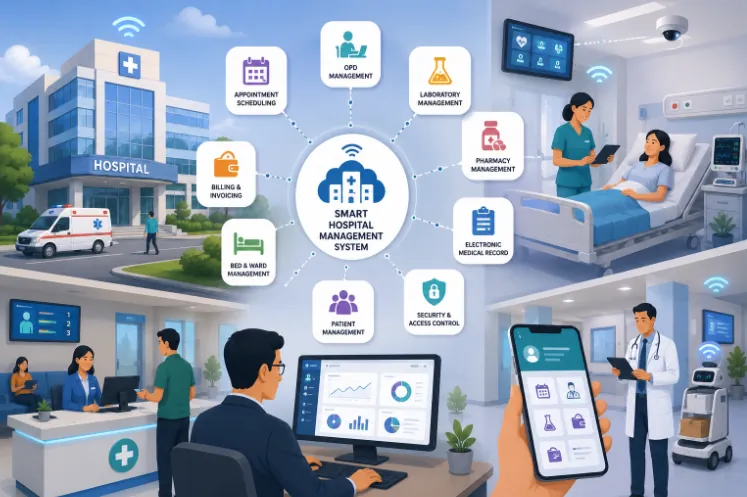
A single-doctor clinic usually needs a simple token and a queue view inside its OPD software. See our guide to OPD software for clinics. A hospital with many doctors, labs and pharmacy counters needs a system that links all the stops. So many hospitals take queue tokens as part of their OPD management software or a full hospital management system.
Common Mistakes to Avoid
- Buying screens but not fixing the process. If one counter does five jobs, a token will not help much.
- No training. Staff must know how to call, skip and recall tokens.
- No priority rules. This leads to fights at the counter.
- Ignoring patients without phones. Keep a printed slip and a display board.
What Affects the Cost?
- The number of counters, doctors and departments
- Display screens, token printers and kiosks
- SMS, WhatsApp or app alerts
- Cloud or on-premise setup
- Link with your hospital software
- Training, support and updates
Ask for a written quote that shows what is included and what costs extra.
How to Choose the Right System
- Walk through your own patient journey. List every stop, from the gate to billing.
- Ask for a live demo. Test a walk-in, an appointment, a senior citizen and a lab token.
- Check the screens. They should be easy to read from a distance, in the language your patients use.
- Check priority rules. Can your policy be set without special work?
- Check the link with registration and billing. Details should not be typed twice.
- Ask about ABHA Scan and Share. See it working, not just on a brochure.
- Review data safety. Ask about access control and backups. See data security and the Digital Personal Data Protection Act, 2023.
- Speak to a similar hospital. They can tell you what daily use is like.
A Simple 30-Day Start Plan
- Week 1. Note your busy hours and slowest counters. Write down your priority rules.
- Week 2. Set up doctors, counters and tokens. Train the front desk.
- Week 3. Start with one department, such as general OPD, and keep a paper backup.
- Week 4. Add other departments. Check the waiting-time report and fix the slowest point.
Frequently Asked Questions
What is a hospital queue management system?
It is software that gives each patient a token number, shows on a screen who will be called next, and tracks the line at registration, doctor rooms, labs, pharmacy and billing. It helps patients know their turn and helps staff manage the crowd.
Is it the same as appointment booking software?
No. Appointment software books a time slot in advance. A queue system manages the line on the day, including walk-in patients, late arrivals and delays. Many hospitals use both together.
Can it handle walk-in patients?
Yes. Walk-in patients get a token like everyone else, and the system places them in the doctor’s queue. This is one of its main uses in Indian OPDs, where many patients come without an appointment.
What about patients who do not use smartphones?
A good system does not depend on phones. Patients can get a printed token slip, watch a display board and hear a voice call-out. SMS or app alerts are an extra for those who want them.
Can it give priority to senior citizens and emergency cases?
It can follow the priority rules that your hospital decides, for example, a separate lane for senior citizens or urgent cases. The hospital must first decide the policy, and then set it in the software.
Does a small clinic need a queue management system?
Not always. A single-doctor clinic may be fine with simple tokens and a queue view in its OPD software. A busy clinic or hospital with many doctors and counters gets more from a full system.
Does it work with ABHA Scan and Share?
Some systems do. Ask whether patients can scan the hospital’s QR code, share their ABHA profile and get a token that way. Ask to see it working.
How much does a hospital queue management system cost in India?
Prices vary. The main factors are the number of counters and doctors, display screens and token printers, SMS or app alerts, cloud or on-premise setup, links with your hospital software, training and support. Ask for a written quote that shows what is included.
Related reading: OPD Management Software · OPD Software for Clinic in India · Hospital Administration Software in India · How Is AI Used in Hospitals? · What Is a Hospital Information System (HIS)?
Conclusion
A queue management system will not add doctors or beds. But it can make the wait clear, fair and easier to manage. Patients know their turn, staff face fewer questions, and managers can see where the crowd builds up. Start with a clear picture of your own patient journey, choose a system that links with the rest of your hospital, and test it with real cases before you buy.
Looking for Queue and Token Software in India? Consider iCAN Careflow
iCAN Careflow is a cloud-based hospital management system made for hospitals and clinics in India. Its OPD module includes queue and token management, where every patient gets a token and the queue for each doctor moves as consultations finish. It also has patient flow tracking, so staff can see who is waiting, who is with the doctor and who is at billing, along with ABHA integration.
If you want queues, registration and billing working from one system, iCAN Careflow is a good choice to shortlist. Ask for a demo, and test it with your own walk-in, appointment and priority cases before you decide.