 INDIA
 USA
Medical Invoicing Software for Smarter Healthcare Billing Across India
Ask any hospital accountant what keeps them up at night, and billing mistakes will come up more often than you'd expect. A missed charge here, a duplicate entry there, a discharge held up because a bill hasn't been finalized — these small slips add up fast. That's the gap medical invoicing software is meant to close, and for hospitals across India dealing with growing patient volumes, it's quickly moving from “nice to have” to something closer to a daily necessity.
So What Is a Medical Invoice, Exactly?
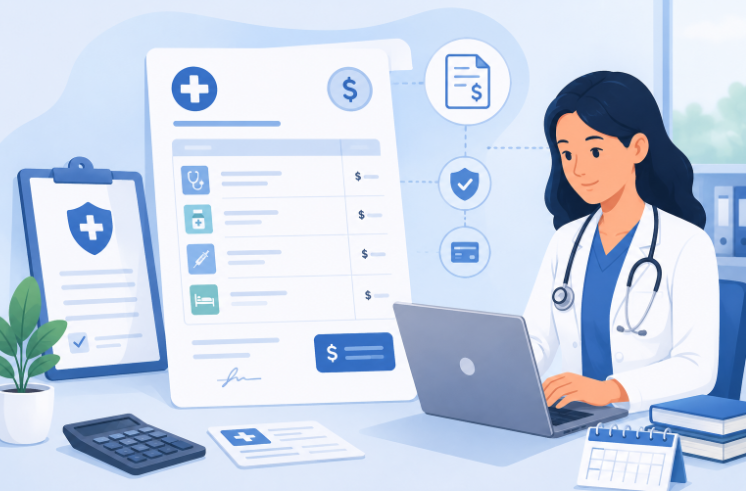
A medical invoice is simply the itemized bill a patient (or their insurer) receives for the care they got — consultation fees, tests, medicines, room charges, procedures, whatever applies. Sounds straightforward, until you consider that a single hospital stay can rack up charges from four or five different departments, each billed differently, all of which need to land on one final, accurate document.
That's really the crux of medical invoicing: it's not one bill, it's dozens of small charges that have to be pulled together correctly, without anything getting lost or double-counted along the way.
Hospital Billing vs Medical Invoicing: They're Not Quite the Same Thing
People often use these terms interchangeably, but there's a useful distinction. Hospital billing is the broader umbrella — it covers everything from patient registration charges to final settlement. Medical invoicing is more specific: it's the actual document generation piece, making sure every charge is captured, calculated correctly, and presented in a format that satisfies both the patient and, where relevant, an insurance company or auditor.
Good medical invoicing software focuses on getting that document right — accurate, itemized, and generated without someone manually re-typing numbers from three different registers.
Billing Looks Different Depending on Where Care Happens
One thing that trips up a lot of billing systems is treating every patient visit the same way. In reality, billing needs shift quite a bit depending on the setting:
OPD Billing
Outpatient billing is usually quick and transactional — consultation fee, maybe a test or two, paid and closed within the same visit. The challenge here is speed. If OPD billing takes too long, it backs up the entire front desk.
IPD Billing
Inpatient billing is a different animal altogether. Charges accumulate over days — room rent, doctor visits, nursing charges, medicines, procedures — and the final invoice only comes together at discharge. Miss tracking something along the way, and it either gets missed entirely or causes a scramble right when the patient is trying to leave.
Pharmacy Billing
Medicines dispensed to inpatients need to tie back to the main hospital bill, while walk-in pharmacy sales are usually billed separately and immediately. Keeping these two flows distinct, without losing track of either, is trickier than it sounds.
Diagnostics Billing
Lab tests and imaging often get ordered by a doctor but paid for separately, sometimes before results are even ready. Diagnostics billing needs to link back to the patient's file so charges don't get orphaned from the rest of their bill.
Why Manual Billing Stops Working Once Patient Volume Grows
A handful of patients a day, manual billing is manageable — someone writes it down, someone else double-checks it, and mistakes get caught before they matter. That approach falls apart quickly once a hospital is handling a few hundred patients daily across multiple departments. There simply isn't enough time for manual cross-checking, and the same slip that used to be a minor inconvenience now happens dozens of times a week.
This is usually the point where hospitals realize billing isn't just an accounts department problem — it directly affects how long patients wait, how quickly claims get settled, and how accurately the hospital understands its own revenue.
Insurance, TPA Claims, and Tax Rules You Can't Ignore
A large share of hospital revenue in India runs through insurance or TPA (Third Party Administrator) claims, and this is where billing gets genuinely complicated. Claims need supporting documentation, pre-authorization in many cases, and have to match exactly what the insurer's policy covers — any mismatch and the claim bounces back, delaying payment for weeks.
On top of that, GST applies differently across healthcare services — some categories are exempt, others aren't, and getting this wrong isn't just a billing error, it's a compliance issue. Hospitals need their invoicing process to apply the right tax treatment automatically, rather than leaving it to whoever's generating the bill that day to remember the rules correctly.
Keeping Track of Payments, Refunds, and What's Still Owed
Generating the invoice is only half the job — someone still has to track whether it's actually been paid. A few things tend to fall through the cracks without a proper system in place:
None of these are dramatic problems individually, but across hundreds of patients a month, unpaid or reconciled amounts can add up to a meaningful chunk of lost revenue. And more often than not, nobody notices until someone finally sits down and reconciles the books properly — by which point, some of that money is genuinely hard to recover.
What Billing Reports Should Actually Tell You
A billing report shouldn't just be a dump of numbers — it should answer specific questions. Which department is generating the most revenue? How much is currently outstanding, and how old is it? Are refunds being processed within a reasonable time? Without this kind of visibility, finance teams end up guessing at the hospital's actual financial health instead of knowing it.
It also helps during audits. When an auditor asks why a particular claim was billed a certain way, having a clean report trail — rather than digging through paper files or scattered spreadsheets — saves hours and avoids the awkward scramble that usually comes with last-minute audit prep.
Billing Errors That Quietly Cost Hospitals Money
Some of the most common (and avoidable) billing mistakes in Indian hospitals include:
Individually, each of these seems minor. Together, over a year, they can quietly cost a mid-sized hospital a surprising amount — either in lost revenue or in the time staff spend correcting disputes later.
A Practical Checklist for Choosing Medical Invoicing Software
If you're evaluating this kind of software for your hospital, it helps to go in with a short list of non-negotiable rather than getting swept up in a feature demo:
Platforms like I Can Care Flow are built around exactly this list — handling billing across departments within one system, rather than leaving hospitals to stitch together separate tools for OPD, pharmacy, and insurance claims. For hospitals that already run on a broader hospital administration software setup, billing that connects into it directly — instead of sitting off to the side as its own disconnected tool — tends to save the most time in day-to-day use.
FAQs
What does medical invoicing software actually automate?
It mainly automates the calculation and generation of itemized bills across departments, applies applicable tax rules, and links charges back to the patient's treatment record so nothing has to be re-entered manually.
Can this kind of software handle insurance and TPA claims directly?
Most capable systems support claim documentation and pre-authorization tracking, though the exact depth varies — it's worth confirming this specifically during a demo rather than assuming it's included.
Is GST compliance usually built into this kind of billing software in India?
Good systems apply GST rules automatically based on the type of service billed, which reduces the chance of manual tax errors on mixed OPD, pharmacy, and diagnostic invoices.
Do small clinics need a dedicated billing system, or is basic invoicing enough?
It depends on volume. A small single-doctor clinic might manage fine with simple billing, but once multiple departments, insurance claims, or daily patient counts start climbing, a dedicated system usually pays for itself in time saved and errors avoided.
Conclusion
Billing rarely gets the attention it deserves until something goes wrong — a delayed discharge, a rejected insurance claim, a refund nobody followed up on. Investing in proper medical invoicing software isn't about chasing the latest technology trend; it's about making sure the money side of patient care runs as smoothly as the clinical side already should. Get that right, and a lot of the day-to-day friction around billing simply stops being a problem.
Curious How I Can Care Flow Handles Billing?
Get a walkthrough of how OPD, IPD, pharmacy, and insurance billing come together in one place — no spreadsheets required.

